~Story~
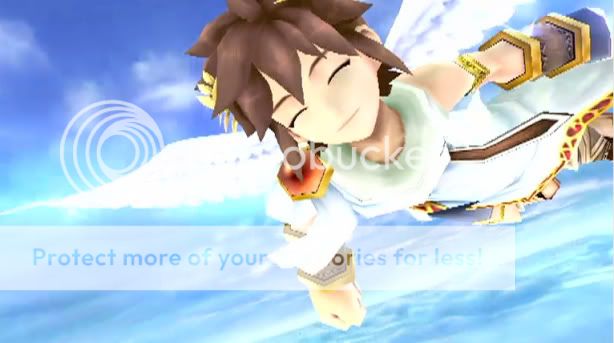
The story within Kid Icarus: Uprising is rather simple, yet intriguing and full of twists. Rather than reveal the whole of the story in a large cutscene at the beginning of the game, Kid Icarus: Uprising reveals key elements of the story chapter by chapter. This method allows for major plot twists. Friends will become enemies, and enemies will become friends. I also enjoy how there isn’t one main enemy, but many different enemies at different parts of the game. That’s as far as I’ll go story-wise however, as to not spoil anything for you.
~Gameplay~
Kid Icarus: Uprising’s gameplay is fun, fast, and frenetic. There are three main gameplay modes within the game. You’ll begin the chapter with a five minute air battle mode. In this mode, you are constantly moving forward, but have the ability to move up, down, right, and left. The purpose of this mode is to destroy as many enemies as possible, and to take in as little damage as you can. In most cases, you will only fly until you get to your desired destination, and then the land battle mode will commence. I found air battle mode to be fun, but the least fun of any of the game modes. Constantly flying and limited freedom wasn't really all for me, and the screen got too cluttered at times, making it hard to tell what was going on.
Land battle mode is responsible for sixty percent of the gameplay, as well as the second portion of each chapter. In this mode, you have a lot more freedom. You are not constantly and automatically moving forward, meaning you have the ability to go in any direction and do some exploring. The main objective in this mode is to make your way to the boss and to take out as many enemies as you can while doing so. In some chapters, there are some minor puzzles. What you have to do is usually obvious; doing it is the hard part. Some enemies can be avoided, but most must be defeated to continue onward. These portions of the game are my personal favorite. It kind of feels like a “less puzzle, more action†Zelda game. Land battles also take about four times as long as air battles.
Every chapter also ends with a boss. I feel that the bosses are the weak point in this game. Most bosses are super easy to defeat, even at high difficulty levels, and don’t have any sort of weak point. All you really have to do is constantly shoot them, and dodge every now and then. I feel that most of these bosses are really awesome in design, but really lacking in gameplay and actual difficulty. However, Nintendo does a great job with making you think you’ve defeated a boss, when you haven’t.
~Visuals~
The only thing I could possibly say negative about Uprising’s visuals, is that it occasionally lags a little when a lot is going on in an online multiplayer match. Aside from that, the game runs and looks absolutely magnificent. The environment is beautiful and colorful. The characters are well drawn and bright. The atmosphere is gorgeous, and sends shivers running down your spine. The enemies are well designed, and bring life into the game. Overall, the graphics and design of Kid Icarus: Uprising are the best we’ve seen yet on the 3DS.
~Sound~
I can’t even begin to tell you how absolutely stellar Kid Icarus: Uprising’s music is. Playing this game is the only time I’ve felt the need to have the 3DS’s volume on max my whole playthrough of the game. The music in this game is right up there with The Legend of Zelda. Another main feature of this game is voice acting. Throughout the entirety of the game, characters will interact with each other. I’ve often heard that this is annoying, but I find it to be entertaining and helpful. Some of the things they say are humorous as well, as characters are constantly cracking jokes about Kid Icarus not having a sequel for 20+ years, and they constantly remind you that you are, in fact, playing a video game. Nintendo has also thrown in some references to other popular video games, some online material, and a few more mature jokes. Overall, the music is brilliant, and the voice acting is well done and entertaining.
~Difficulty~
Kid Icarus: Uprising has a unique difficulty scale, unlike any other video game I’ve ever played. You can choose from a total of ninety different difficulty levels, ranging from 0.0 to 9.0. The standard for difficulty is 2.0. You can wager hearts, the main currency obtained from slaying enemies, to either increase or decrease the difficulty. The greater the difficulty, the harder the game becomes and the more enemies there are to fight. However, the rewards from completing chapters on higher difficulties are also greater. Unfortunately, upon dying, the game will automatically drop you an intensity level, making challenging yourself quite difficult. Throughout land battles in various chapters, if you explore enough, you will come across intensity doors. You can only go through intensity doors if you are playing on the intensity that particular door requires. Within said doors, lie a few enemies, and a few treasure chests. Within said treasure chests, lie heaps of rewards, namely weapons and power-ups. On my first playthrough of the game, I stuck with a difficulty level of 3.0 to 4.0. However, even at such a low intensity level, I found the game quite difficult later on.] Having said this, Kid Icarus isn’t an easy game by any means.
~Controls~
This game’s controls are the most controversial aspect within the game. I’ve heard so many complaints about them, even though I found them quite comfortable to use. The basic control scheme consists of using the stylus on the touch screen to switch the direction your facing/aiming, the circle pad to move around, and the L button to fire, although you may make minor adjustments. Like I said, I didn’t have any problems with these controls, although I can see how left handed people would have major problems. However, the circle pad pro is compatible.
~Multiplayer~
Kid Icarus: Uprising features online or local multiplayer options. There are two multiplayer modes, both of which are based off land battle mode in the solo mission. The first is called Light vs. Dark. Light vs. Dark puts six players head to head, on two different teams. Your main goal is to defeat players on the opposing team, without letting yourself be defeated. When a player on your team is defeated, your team’s life gauge goes down, depending on how much power that player’s chosen weapon has. When your team’s life gauge has been completely depleted, the last player to die on your team will be reincarnated as Pit/Dark Pit. When Pit/Dark Pit has been defeated, the other team wins. I found this mode to be fun and entertaining, but not as much as the second multiplayer mode, free for all. Like the title suggests, free for all mode is simply that, a fight to the death between all six players. Also worth noting, in free for all mode, the rewards for winning seem to be greater. Even though the game has only been out a few days, there are already a lot of really good players online. Overall, the multiplayer modes are fun, but definitely not the main reason you want to purchase the game.
~Conclusion~
While the main story might only last ten hours, there are hundreds of different weapons (nine different categories, with a lot of weapons within each category) a ton of different achievements, and over ninety different difficulty levels. This game is seriously bursting with content. The visuals are gorgeous, the characters are light-hearted and funny, and the music is stellar. There is no reason that this game isn’t worth $40 and more. Kid Icarus: Uprising most definitely does this renewed franchise it’s long awaited justice.
Overall Score: 9.5/10
***-[Pocodudeface]-***
About the Author:
Rial Johnson
Rial Johnson founded Nintendo Castle in 2011 with hopes to build the largest collection of Nintendo walkthroughs, guides, and content on the web. He is an avid gamer with a special place in his heart for Nintendo, but often finds himself writing about games more than actually playing them. You'll likely see him around Nintendo Castle and on social media, mostly managing the front-end content of the site.


 Nintendo Castle turns 15 today. Happy Birthday? Anniversary? Whatever you want to call it, NC has ...
 Nintendo surprised us this morning by revealing a rather large update for Animal Crossing: New Hor...
 A brand new entry in the Fire Emblem series is coming to Switch 2. It's called Fire Emblem: Fotrun...
 Kirby Air Riders is getting a new line of amiibo. It starts with Kirby & Warp Star and Waddle ...
 In a move that no one expected (or thought was a good idea), Nintendo has decided to try their han...
